
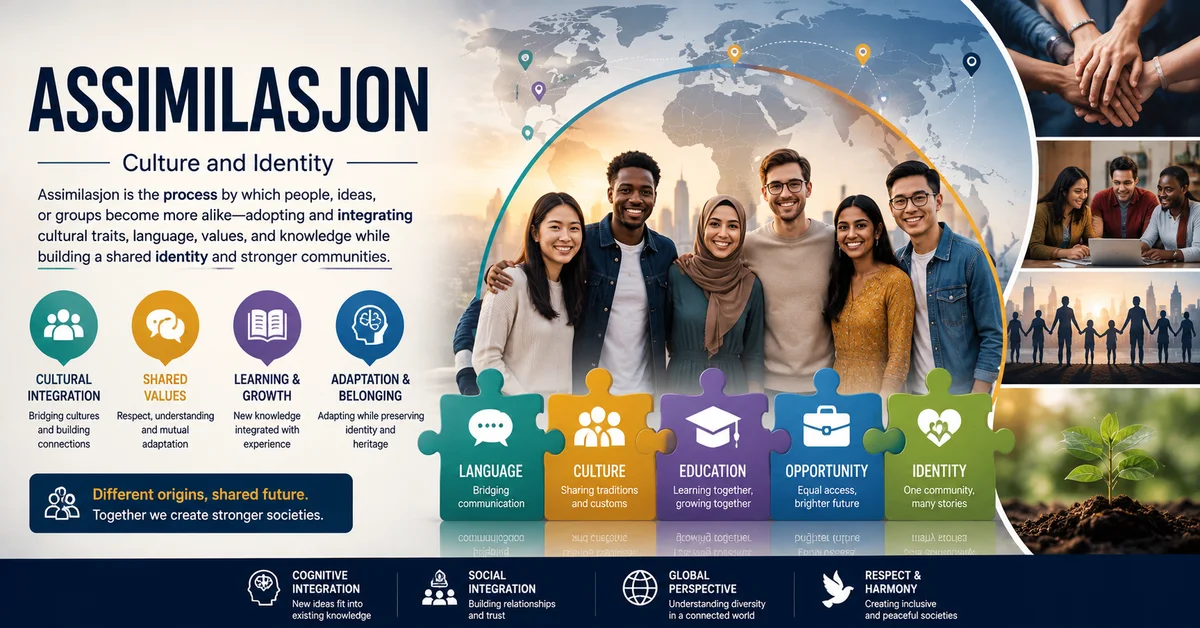
Assimilasjon: Culture and Identity
Assimilasjon describes the process by which people, ideas, or groups become more alike—often when a minority adopts traits of a dominant culture or when new information fits into existing mental patterns. The concept applies both to social life (cultural assimilation, language assimilation, immigrant assimilation) and to psychology (how learners fit new facts into existing schemas). Used carefully, the idea helps us understand how individuals and communities adapt while keeping an eye on identity and human dignity.
In today’s multicultural world, assimilasjon matters because migration, digital communication, and globalization bring different cultures into frequent contact. Knowing how cultural adaptation happens helps policymakers, educators, employers, and families support smoother social integration and greater social belonging while reducing conflict. Framing assimilasjon positively—emphasizing mutual respect and cultural diversity—can make communities more resilient and creative.
The term has roots in both sociology and psychology. Early sociologists used related ideas to describe how immigrant groups become part of host societies; developmental psychologists later used the term to describe cognitive processes. Modern scholarship treats assimilasjon as a spectrum (from voluntary cultural adaptation to pressured conformity) and studies both its benefits and trade-offs in multicultural societies.
Understanding Assimilasjon
What is assimilasjon? Definition and meaning
At its core, assimilasjon refers to making something similar or bringing it into harmony with the surrounding context. In cultural terms, it often means adopting the language, customs, or norms of a dominant culture. In psychological terms, assimilasjon means integrating new experiences into an existing mental framework, a key step in learning and cognitive development. Both uses share the same idea: change through incorporation.
Assimilasjon in sociology and culture
Sociologists study assimilasjon alongside integration and acculturation. Cultural assimilasjon can help newcomers access education, work, and social networks, often easing everyday life. However, sociologists also point out risks—like loss of cultural heritage or unequal pressure placed on minority groups—so modern approaches emphasize respectful two-way adaptation rather than one-sided conformity.
Assimilasjon in psychology and learning theories
In psychology, assimilasjon is a technical term used by developmental theorists to explain how people interpret new information. Learners fit new facts into existing schemas (mental structures). This cognitive assimilasjon helps explain how children learn language, categorise objects, and build understanding. It’s complementary to accommodation, where schemas themselves change to accept new information.
Psychological Perspective of Assimilasjon
Cognitive development and assimilasjon
Cognitive development depends on both assimilasjon and accommodation. When children encounter something new, they either fit it into what they already know (assimilasjon) or change their mental model (accommodation). This interplay drives intellectual growth. Recognizing when learners are assimilating versus accommodating helps educators design lessons that scaffold understanding effectively.
Assimilasjon in learning processes
In classrooms, assimilasjon appears when students relate new concepts to prior knowledge—linking a new math idea to a familiar pattern, for example. Effective teaching encourages this by activating background knowledge, using examples, and prompting reflection. Learning-by-assimilation is efficient because it leverages existing mental structures to incorporate related ideas quickly.
Assimilasjon vs accommodation in cognitive theory
Assimilasjon and accommodation are two sides of the same learning coin. Assimilasjon maintains stability by integrating new data into existing frameworks; accommodation allows frameworks to evolve. Both are necessary: too much assimilasjon can lead to misunderstanding (forcing new facts into incorrect categories), while too much accommodation can disrupt previously useful schemas. Good instruction balances them.
How children develop knowledge through assimilasjon
Children absorb language, social rules, and object categories largely through assimilasjon early on. For instance, a toddler who calls all four-legged animals “dog” is assimilating new creatures into an existing category; with correction and exposure, they accommodate and refine categories. Parents and teachers who provide gentle correction, rich examples, and safe practice spaces accelerate accurate knowledge formation.
Cultural and Social Assimilasjon
Cultural assimilasjon and identity formation
Cultural assimilasjon affects personal identity because people often integrate new cultural elements into their self-concept. Some embrace new customs while consciously preserving traditions from their origin. Identity formation is dynamic: many people develop blended identities that reflect both heritage and new cultural influences, contributing to rich, hybrid cultures.
Assimilasjon in multicultural societies
Multicultural societies face the challenge of enabling social integration while preserving cultural diversity. Policies that encourage language learning, civic participation, and anti-discrimination strengthen social cohesion without forcing complete cultural conformity. Successful multicultural communities tend to support both cultural adaptation and heritage preservation.
Migration and immigrant assimilasjon
Immigrant assimilation often involves learning the host country’s language, norms, and economic practices. This process can unlock opportunities—employment, education, social support—but may be uneven due to structural barriers like discrimination or credential recognition. Programs that combine language assimilation with recognition of existing skills produce better outcomes.
Language assimilation and communication
Language assimilation is a practical gateway to broader social integration. Mastering the dominant language improves access to jobs, healthcare, and civic life. Yet bilingualism offers cognitive and cultural advantages; many communities successfully combine language assimilation with maintaining heritage languages across generations.
Social integration vs assimilasjon
Integration is broader and often less one-sided than assimilasjon. Social integration seeks two-way adaptation: newcomers gain access while the host society adjusts norms and institutions to be inclusive. Framing policies around integration rather than forced assimilation tends to produce more equitable, stable social outcomes.
Real-World Examples of Assimilasjon
Assimilasjon in global societies
Around the world, communities show different assimilation patterns. In some countries immigrants assimilate rapidly through education and labor market inclusion; in others, segregation or xenophobia slows assimilation. Globalization has accelerated cultural exchange, leading to hybrid cultural forms in cities everywhere—culinary fusions, multilingual neighborhoods, and blended traditions.
Historical examples of assimilasjon
History offers many assimilation examples: minority cultures adopting the legal or linguistic norms of dominant empires, or local customs melding with colonial influences. Some historical assimilations were voluntary and innovative; others were coercive. Studying history helps us identify ethical practices that preserve dignity while supporting adaptation.
Assimilasjon in modern urban communities
Big cities are assimilation laboratories: neighborhoods often reflect waves of immigration, with newcomers learning local norms while opening businesses, arts, and cuisines that reshape the urban culture. Urban assimilasjon is frequently mutual—hosts learn from newcomers too—creating vibrant multicultural scenes.
Assimilasjon and globalization effects
Globalization increases contact between cultures via media, travel, and commerce. Cultural assimilation now flows both ways: global pop culture shapes local tastes while local practices gain international attention. This exchange can democratize creativity but also intensify tensions when local communities feel overwhelmed by rapid change.
Positive and Negative Effects of Assimilasjon
Benefits of assimilasjon in social harmony
When handled respectfully, assimilasjon promotes social belonging, reduces communication barriers, and facilitates economic participation. Language assimilation and social integration help newcomers access rights and services, improving well-being and contributing to shared civic life. Blending cultures can also spark innovation and broaden perspectives for everyone.
Challenges and risks of cultural assimilation
Forced or rapid assimilation risks cultural identity loss, emotional alienation, and intergenerational tensions. When minority cultures are expected to abandon traditions to gain acceptance, communities can lose intangible heritage—languages, rituals, and arts—leading to irretrievable cultural erosion.
Cultural identity loss and preservation debates
Scholars and communities debate how to balance assimilation with preservation. Many now favor policies that protect minority culture while encouraging participation in public life. Programs that fund cultural centers, bilingual education, and heritage festivals help preserve identity while enabling assimilation where it’s beneficial.
Assimilasjon and social conflicts
Poorly managed assimilation can fuel social conflict—mistrust, scapegoating, or backlash against perceived cultural change. Transparent policies, inclusive institutions, and intercultural dialogue reduce these risks and help societies choose pathways that respect both diversity and social cohesion.
Assimilasjon in Education
Role of assimilasjon in teaching methods
Teachers leverage assimilasjon by connecting new material to students’ prior knowledge—linking unfamiliar concepts to familiar contexts. Culturally responsive pedagogy acknowledges learners’ backgrounds and uses them as strengths, allowing assimilation of academic content without erasing cultural identity.
Assimilasjon in student learning development
Educational systems that balance assimilasjon and accommodation foster deeper learning. For example, bilingual programs can support language assimilation while maintaining academic progress in the student’s first language. This dual approach reduces learning loss and fosters social belonging.
Education policies and cultural diversity
Policy choices affect how assimilasjon unfolds. Inclusive curricula, teacher training in multicultural competencies, and language-access services help students from diverse backgrounds thrive. Policies that respect cultural diversity while teaching shared civic values tend to yield both academic success and social integration.
Academic Theories Related to Assimilasjon
Assimilasjon in developmental psychology theories
The developmental theory associated with Jean Piaget frames assimilasjon as a cognitive process: children incorporate new experiences into existing schemas. This idea is foundational in understanding how learners construct understanding across age ranges.
Scientific studies about assimilasjon
Empirical research shows consistent patterns: language acquisition speeds integration; inclusive institutions improve outcomes; forced assimilation harms mental health. Cross-disciplinary studies—from sociology to education—support the consensus that respectful, two-way approaches to cultural adaptation are most beneficial.
Sociological theories of cultural adaptation
Sociologists model assimilasjon with typologies—from straight-line assimilation to segmented assimilation—highlighting how socioeconomic context, discrimination, and community resources shape outcomes. These frameworks help policymakers design interventions that address structural barriers, not just individual choices.
Assimilasjon and Personal Identity
Cultural heritage and identity preservation
Preserving cultural heritage supports mental health and community continuity. Many individuals create hybrid identities that combine ancestral practices with new cultural elements—celebrating festivals at home while speaking a dominant language in public. Encouraging cultural transmission within families and communities strengthens identity while allowing external adaptation.
Generational differences in assimilasjon
Generational patterns often emerge: first-generation immigrants may emphasize heritage, second-generation often blend both cultures, and later generations may further transform identity. Understanding this helps families and institutions support intergenerational dialogue and reduce conflict.
Social belonging and emotional adaptation
Belonging is the emotional heart of successful assimilation. When newcomers feel accepted without sacrificing core identity, mental health and civic engagement rise. Community programs, mentorship, and inclusive public narratives foster belonging and reduce the sense of cultural dislocation.
Modern World & Future of Assimilasjon
Assimilasjon in digital society
Digital spaces accelerate cultural exchange and provide tools for both assimilation and preservation: online language courses, virtual cultural events, and heritage archives help communities adapt while keeping traditions alive. Social media also allows cultural expressions to reach global audiences, reshaping what assimilation looks like.
Globalization and cultural blending
Global flows of people, ideas, and media make culture more fluid. The future likely holds even more blended identities and creative cross-cultural forms. Societies that prioritize mutual respect, equitable opportunities, and cultural literacy will be best positioned to harness these trends.
Future trends of cultural assimilasjon
Expect hybrid cultural practices, multilingualism as a norm in many places, and educational models designed for cultural diversity. Policymakers focused on inclusive integration—rather than coercive assimilation—will cultivate resilient, innovative communities.
Summary
Assimilasjon is a multifaceted process—psychological and social—through which individuals and groups adapt to new contexts. When guided by respect, supportive policy, and inclusive education, assimilasjon fosters belonging, opportunity, and creative cultural exchange. When driven by coercion or inequality, it risks identity loss and social conflict.
The healthiest path forward balances adaptation with cultural preservation. Emphasize two-way integration, support heritage languages and customs, and design education and social policies that treat cultural diversity as an asset. By doing so, societies can enjoy the benefits of assimilation—social harmony, economic opportunity, and shared belonging—without erasing the rich tapestries that make communities unique.
Frequently Asked Questions
What is the difference between assimilasjon and integration?
Assimilasjon often implies one-sided change—minority adopting dominant norms—while integration suggests mutual adaptation and inclusion. Integration prioritizes two-way accommodation and policy changes that reduce structural barriers.
Is assimilasjon always bad for cultural identity?
Not always. Voluntary assimilation can bring practical benefits without erasing identity—especially when individuals retain heritage practices. Problems arise when assimilation is forced or when structural pressures make cultural preservation impossible.
How does assimilasjon affect identity?
It can reshape identity by blending old and new cultural elements. Many people form hybrid identities that draw from both heritage and the host culture. Programs that support cultural transmission help maintain continuity.
How do children learn through assimilasjon?
Children fit new experiences into existing mental schemas. Teachers and parents support this by relating new material to prior knowledge and providing corrective feedback that leads to accurate accommodation when necessary.
What are benefits of assimilasjon for societies?
Benefits include improved communication, economic participation, shared civic life, and cross-cultural creativity. When combined with policies that protect diversity, assimilation can strengthen social cohesion.
Stay in touch to get more updates & alerts on bytemag.tech! Thank you.